
Compare Chautauqua County Property Values
One parcel can carry several valid figures at once. An appraisal, an assessment, and a recorded sale price measure different things. So they should never be swapped. Each Chautauqua County property value belongs to its own record. The county publishes no online parcel-card portal, so confirm exact fields with the Appraiser's office.
| Value | What It Is | Where |
|---|---|---|
| Appraised value | The county's mass-appraisal estimate for the assessment year | Appraiser record and value notice |
| Assessed value | Appraised value multiplied by the constitutional rate for its class | Appraiser record |
| Last sale price | Consideration tied to a recorded transfer, if disclosed in the record | Register of Deeds instrument |
| Taxable county total | An aggregate used for countywide context, not a parcel estimate | KDOR county summary |
In Kansas, classification drives the math. The assessed value equals appraised value times a class rate. Residential, multifamily, and mobile-home property is assessed at 11.5%. Vacant lots sit at 12%, and public utilities at 33%. Agricultural land uses 30% of use value. Agricultural improvements and commercial real property carry a 25% rate. Other real property carries 30%.
Chautauqua County Value Formula
The Kansas Department of Revenue lays out the sequence plainly. Appraised value multiplied by the constitutional assessment rate gives assessed value. Assessed value multiplied by the mill levy and divided by 1,000 gives the tax.
Classification changes everything. A residence, an agricultural tract, a commercial building, an oil or gas interest, and a utility parcel may not share a rate or a valuation method. Confirm the class on the same year's record before running any calculation. Tax bills and appeals sit with the county tax records.
The statewide formula applies across Kansas. The county Appraiser supplies the parcel facts. View the Kansas property valuation formula to see the official math.
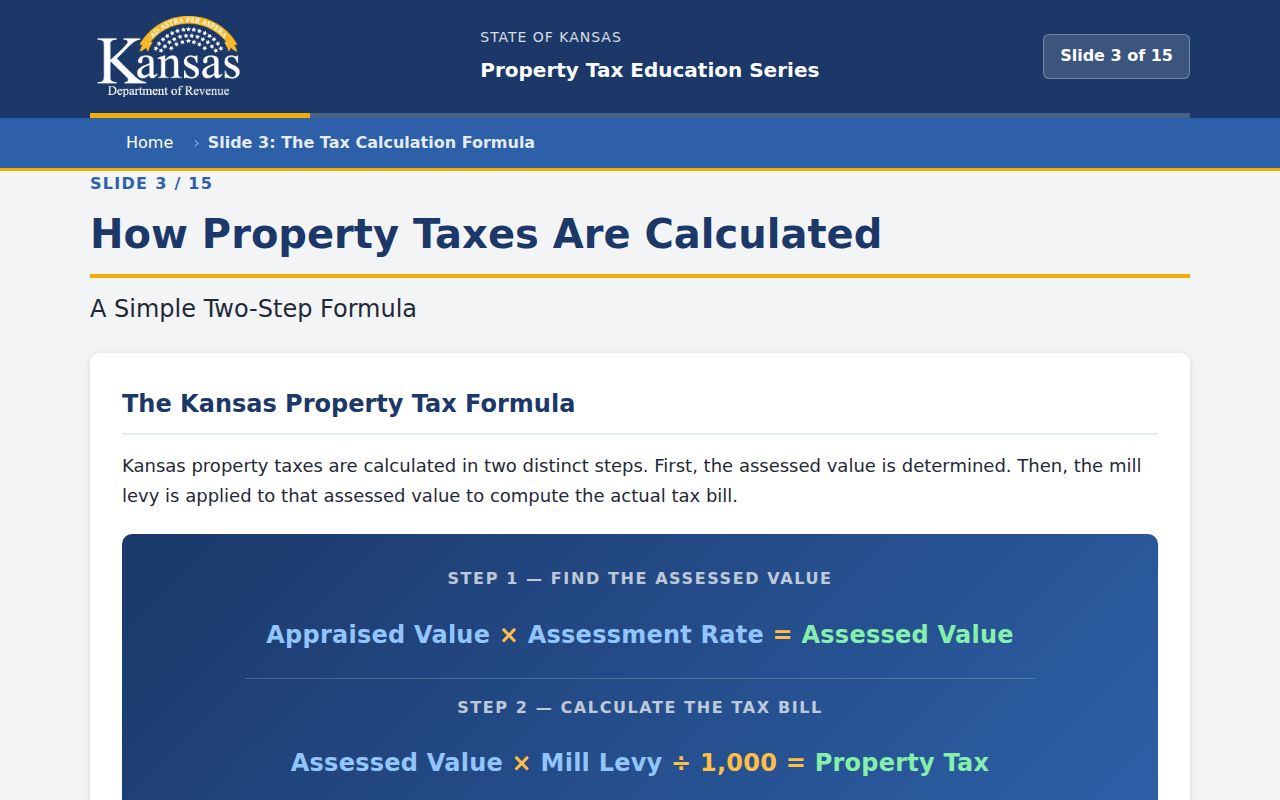
The image reinforces a key point: an assessed amount reflects the tax roll, not the market, so it must not be compared directly with an asking price.
2025 Chautauqua County Value Mix
KDOR's 2025 county summary reports $42,713,707 in total taxable value. Residential property holds 30.30% of the class mix and public utility 28.70%. Agricultural land accounts for 24.77%. Agricultural improvements add 4.84%. Oil and gas sits at 4.03%. Commercial real property makes up 3.89%.
Those percentages describe the county tax base. They say nothing about any one parcel. A farm, a well, or a storefront can move against the county average. Countywide totals can shift even when one neighborhood stays flat.
2026 Chautauqua County Market Study
The county's 2026 market-study page covers 2025 residential sales. Market changes ran in a broad zero-to-twelve-percent range. Most of the data landed between five and ten percent. Vacant land showed no discernible trend because the data was limited. Commercial and industrial data was mixed, with no statistically defined trend.
One caution applies. The page carries an old March publication line left over from a template. Rely on the current assessment-year notice and the statutory calendar instead. A range is not a parcel adjustment. Ask the Appraiser which data and property traits were used for the subject parcel.
Open the official Chautauqua County market study. Compare its wording with the current value record.
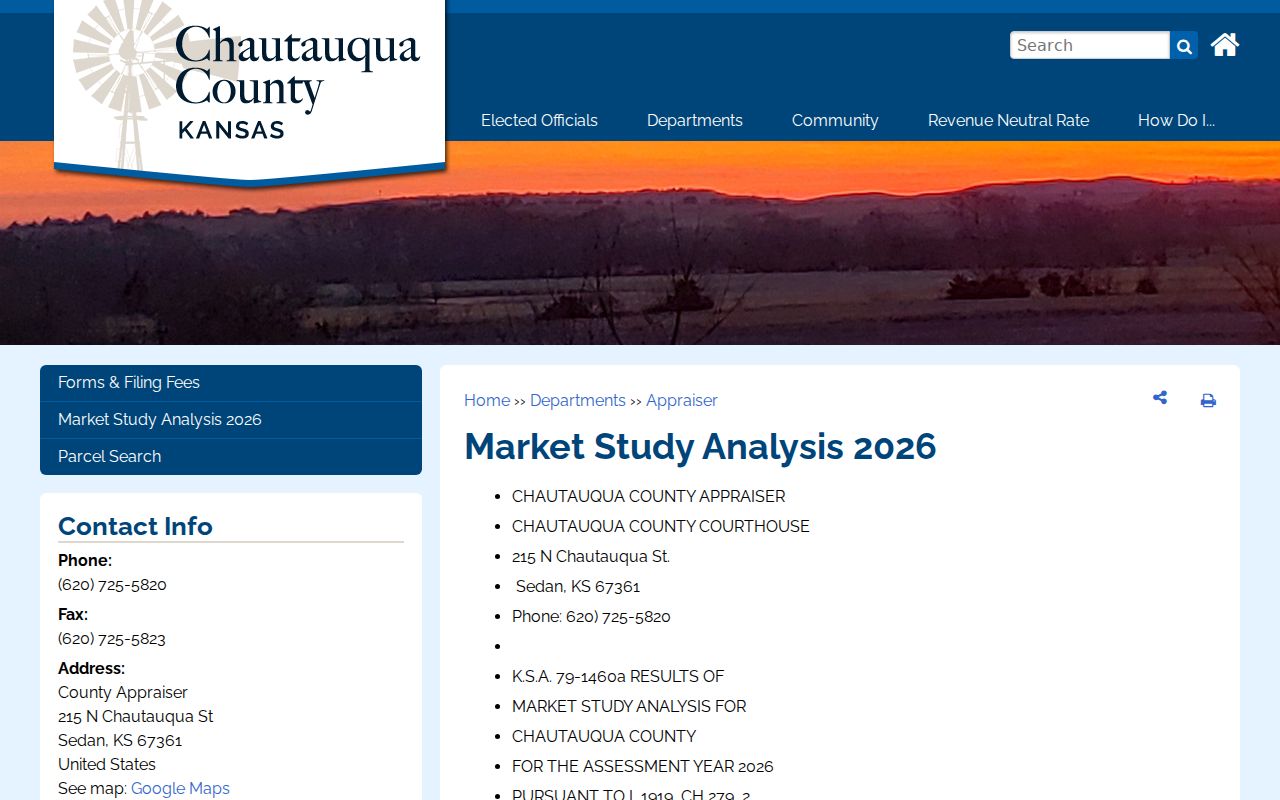
The market ranges should stay county context, not become a home-price estimate.
Estimate Chautauqua County Assessed Value
The county offers no online parcel-card search. Call Appraiser Jeremy A. Hendren at 620-725-5820 or visit the office at 215 N Chautauqua St in Sedan. Give the exact address, the parcel or tax ID, and the legal description. Ask for the assessment year attached to every figure.
- Ask the Appraiser for the appraised value, assessed value, classification, and year.
- Check the math with the Kansas rate for that class, without assuming every parcel is residential.
- Ask the Register of Deeds for the latest transfer and any stated consideration when sale context is needed.
- Date the results and keep exemptions or the tax bill separate from the value comparison.
- Assessed value
- The appraised value after the class rate is applied.
- Appraised value
- The county's mass-appraisal estimate for its assessment work.
- Assessment rate
- The constitutional percentage assigned to a Kansas property class.
- Consideration
- The value exchanged in a transfer, as the instrument may state it.
- Reassessment
- A later valuation for a new assessment year.
Flood Maps and Chautauqua County Value
Two timely sources support flood diligence here. One is KDA's 2026 draft floodplain review. The other is the county's April parcel list. The list exposes parcel IDs, owner fields, mailing and property addresses, and a new-floodplain field, though it is not a complete roll and rows may repeat.
A draft map raises questions; it settles none. It cannot set market value or final flood status, so preserve the layer date and review label and ask whether a final map or county action has replaced them. Pair the parcel with its legal description rather than trusting the polygon alone.
Recorded Sales in Chautauqua County
The Register of Deeds confirms any recorded transfer. The office publishes no online grantor-grantee search or county fee sheet. Call with owner name variants, a parcel key, the legal description, and a rough date. Then ask for the newest deed reference.
A recorded price can sit far from open-market value. Related-party transfers, partial interests, estate work, and bundled property all play a part. Other terms visible only in the deed matter too. One sale is not an appraisal. If you need a copy, ask the Register first. Ask for the page count and the current charge.
Chautauqua County Value Record Limits
An assessed value is one input in the tax formula. It does not predict what a buyer will pay. Nor is it a site-specific appraisal of the property. Countywide studies lump many sales and property traits together. The resulting figure reflects broad averages rather than any single address. A price on a recorded deed is just one event. It leaves out condition, financing terms, minerals, easements, and repair needs. For a real opinion of value, get a qualified appraisal. For the meaning of the county's number, ask the Appraiser about the record. Ask about the year, class, data, and notices tied to it.
Value vs price. Chautauqua County assessed value serves taxation. It is not a sale forecast, title opinion, or parcel-specific appraisal.