
Separate Chautauqua County Property Tax Record Fields
Value and money live in different offices. Appraiser Jeremy A. Hendren keeps the value side. His records cover classification, appraised and assessed value, agricultural use value, exemptions, market studies, and appeals, while Treasurer Amy Goode handles bills, receipts, balances, interest, delinquency, redemption, and tax-sale information.
| Field | What It Shows | Where |
|---|---|---|
| Appraised value | Valuation before the constitutional class rate | Appraiser |
| Assessed value | Appraised or use value after the applicable rate | Appraiser |
| Class / exemption | Tax category and any approved exemption | Appraiser |
| Bill and status | Amount, payment, interest and delinquency | Treasurer |
| Taxing district | County, city, school and special-unit levies | Statement / Treasurer |
A tax bill is not a sale-price record. Kansas runs a two-step formula. Appraised value times the assessment rate gives assessed value; assessed value times the mill levy, divided by 1,000, gives the tax. The rate depends on classification. Residential and qualifying multi-family or mobile property is assessed at 11.5%, vacant lots at 12%, commercial real property and agricultural improvements at 25%, other real property at 30%, agricultural land at 30% of use value, and public utilities at 33%.
Chautauqua County Property Tax Formula
Start with the parcel itself. Pull the assessment year, classification, appraised or use value, assessed value, and actual taxing district before doing any math. A countywide average levy or class percentage can never replace the parcel-specific levy printed on the statement.
- Appraised value
- The valuation starting point.
- Assessed value
- The class-adjusted value used in the tax formula.
- Mill levy
- Tax per thousand dollars of assessed value.
- Exemption
- A statutory exclusion requiring the appropriate filing and approval.
- Tax lien
- A claim arising from unpaid tax, distinct from the bill itself.
The Kansas Department of Revenue formula appears in the source view below.
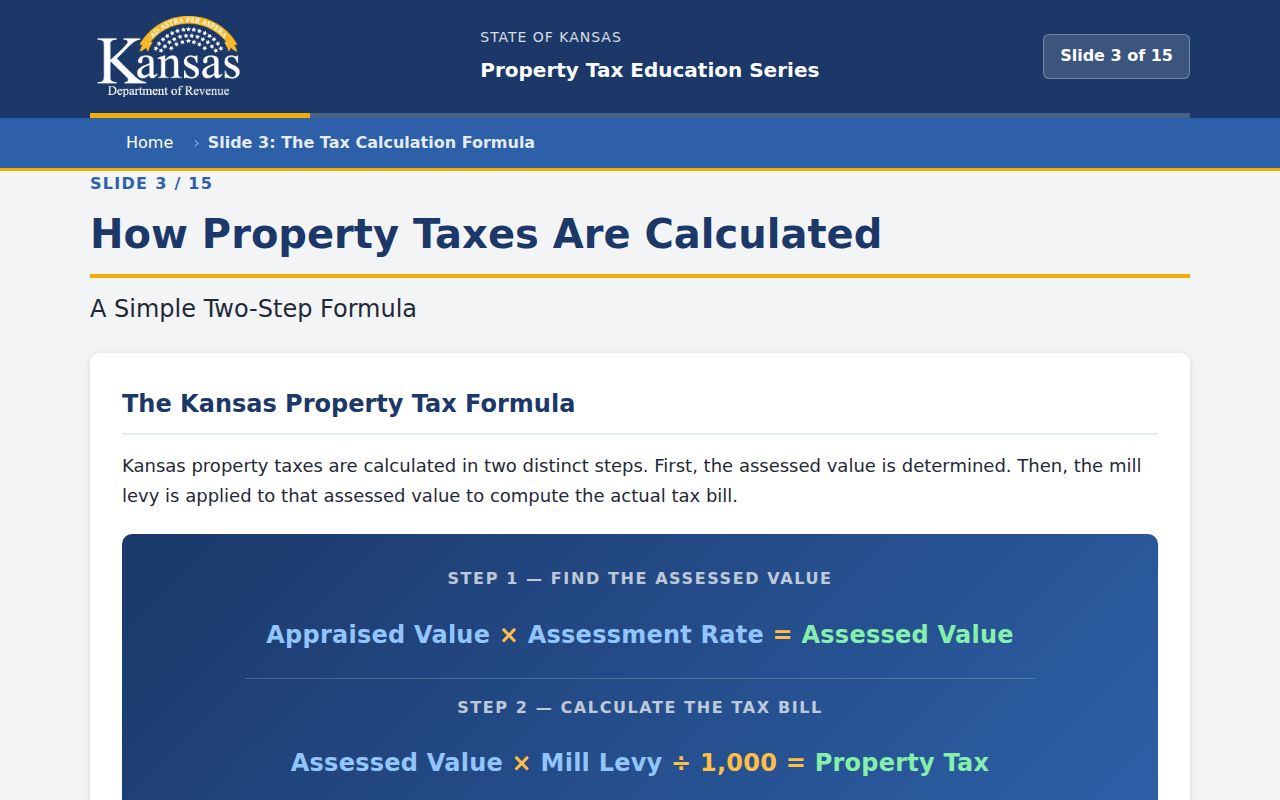
Apply the formula only to matching parcel and year.
Read the 2025 Chautauqua Countywide Snapshot
KDOR's 2025 summary sets the countywide context. Total taxable value was $42,713,707; ad valorem tax, $6,635,687. Per-capita value ran $12,762 against $1,983 in per-capita tax, on an average mill levy of 0.155356 and a 2024 population of 3,347. These are county-level figures. They are context, never a parcel estimate. Reported value shares run residential 30.30%, public utility 28.70%, agricultural land 24.77%, agricultural improvements 4.84%, oil and gas 4.03%, and commercial real property 3.89%. By district, the county holds 53.58% and cities 7.08%, with the state and named special units making up the remainder; preserve the summary's labels and year.
Look Up a Chautauqua County Tax Bill Offline
The county publishes no live account-search portal. Start with the official billing page and contact the Treasurer at 215 N Chautauqua Street, Sedan, 620-725-5810, Monday through Friday, 8:00 a.m. to 4:00 p.m.
- Ask the Appraiser for the exact Parcel or Tax ID and assessment-year values.
- Give the Treasurer that identifier and specify the tax year.
- Request the bill, payment history, current balance, interest and delinquency.
- Compare assessed value, class and taxing district to the Appraiser record.
- Request an official receipt or statement when reliance matters.
- First half
- Real-property payment is due December 20.
- Second half
- Due May 10; the county does not mail a second-half statement.
- Interest
- Begins December 21 for real property.
- Card payment
- The county states a 2.49% charge.
The county billing source below confirms these operational details.
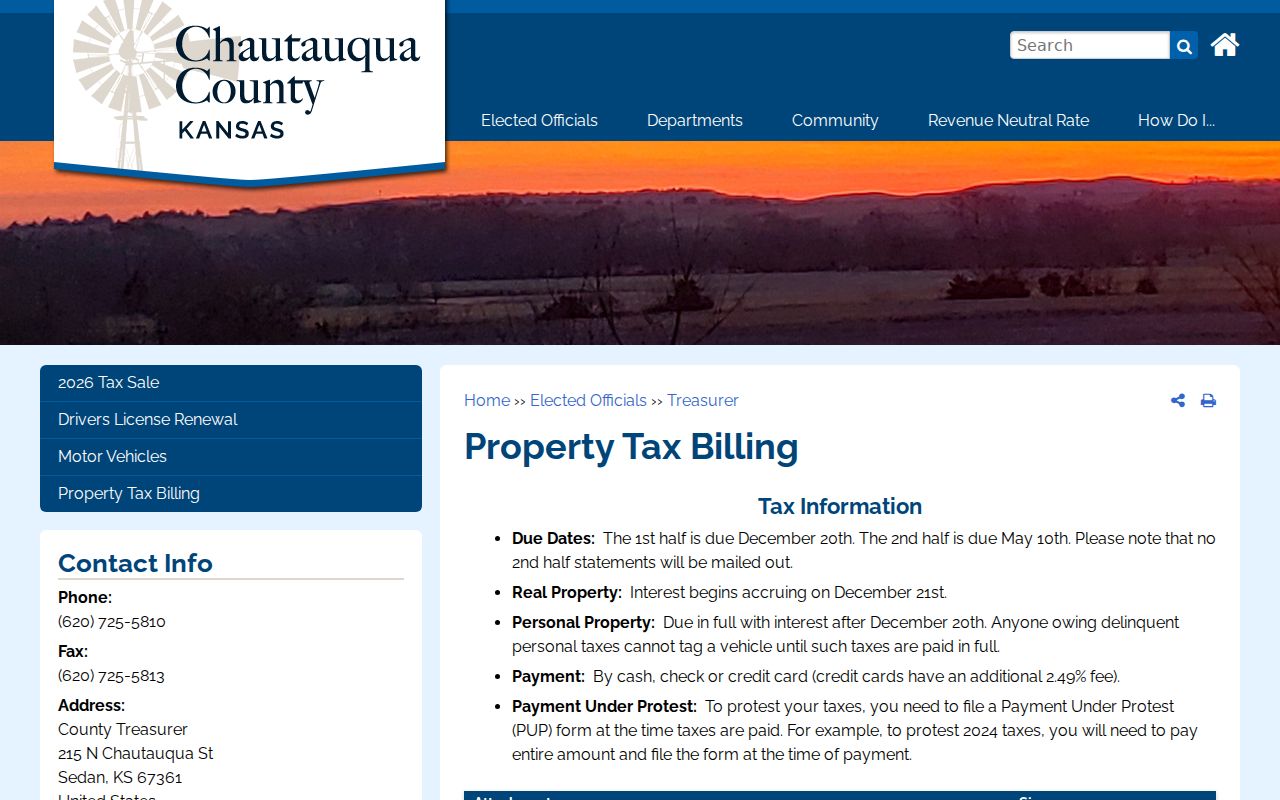
Confirm the account before you pay. Interest and balances depend on the parcel and the date.
Chautauqua County Property Tax-Sale Search
The county's official 2026 tax-sale page lists each property by Parcel, Tax ID, Owner Name, Property Address, City, and Zip. The sale date was still to be announced. Notice goes out four to six weeks ahead through the official newspaper, the county website, and the Treasurer's phone line. Redemption required current and delinquent taxes plus $535 in tax-sale fees by close of business the day before the sale, unless the Treasurer is notified. Confirm the amount and deadline first. A row still proves little by itself. The table shows the public field structure. A listing does not establish current ownership, marketability, condition, or a completed sale.
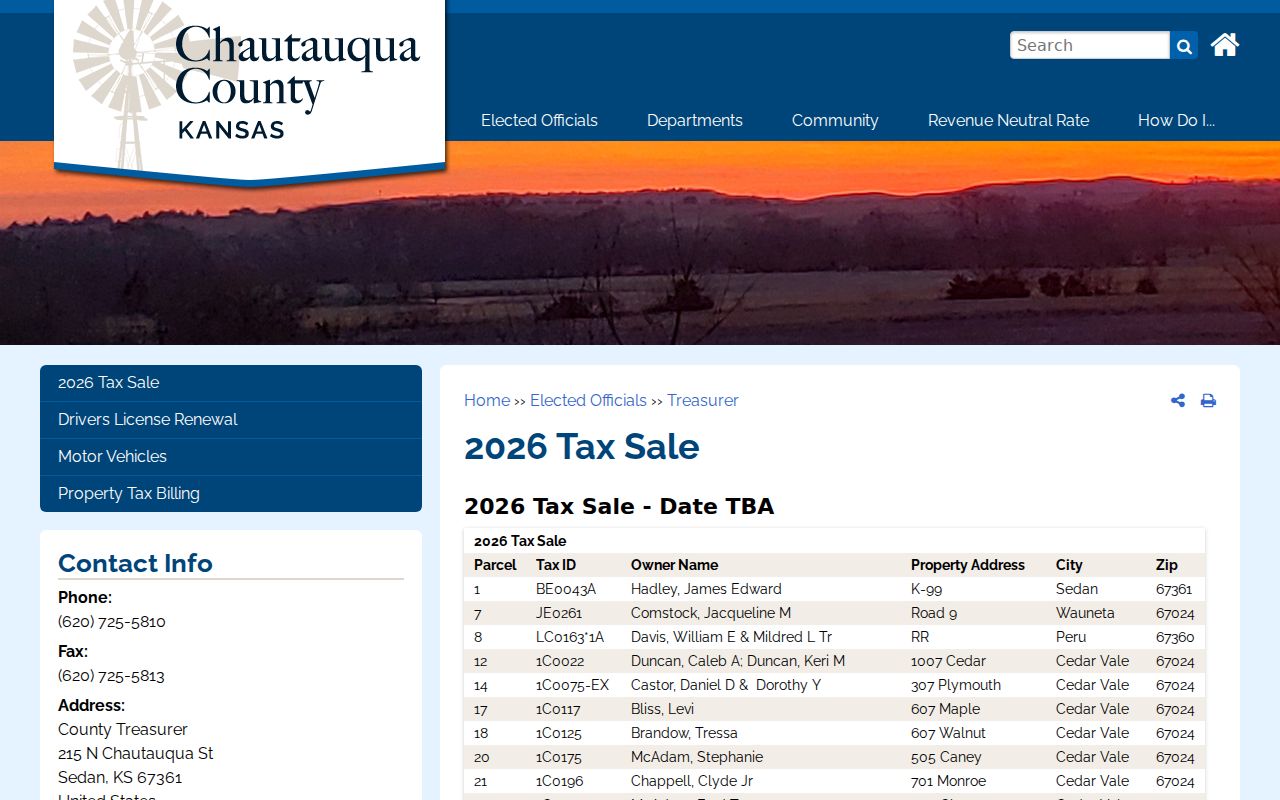
Take both identifiers to the Appraiser and Treasurer.
Appeal a Chautauqua County Assessment by the Notice Date
KDOR's calendar puts valuation notices out March 1. The equalization window is 30 days from notice. The informal meeting deadline is May 15. The final determination is May 20. Appraiser certification is June 1. BOTA appeals generally run 30 days from the informal decision. A single-property appraisal appeal gets 60. Confirm the current notice and procedure. The Appraiser's forms page carries Payment Under Protest, tax-exemption, and low-producing oil-lease forms. Payment Under Protest has strict timing. It must be filed when payment is made, with the entire tax paid. Assemble the notice, property description, comparable evidence, classification issue, photographs, and factual corrections. Do this before the informal meeting.
Appeal window. The equalization deadline runs from the valuation notice; verify the mailed date and current form with the County Appraiser immediately.
Interpret Chautauqua's 2026 Market Study Carefully
The county's market-study page covers assessment year 2026 under K.S.A. 79-1460a. Residential markets rose in 2025. Increases ranged from 0 to 12 percent, with most data falling between 5 and 10. Vacant land stayed flat or trendless. Limited data explains that. Commercial and industrial evidence was similarly mixed, with no statistically defined trend. Ignore the stale "March 1, 2021" template line. Rely instead on the current statutory calendar and your parcel notice. A county trend is context, not proof that any particular assessment is right.
Trace Delinquency Through Three Chautauqua Offices
Resolution 2022-05 spells out the county's path. Parcels the county bought at a 2018 or earlier statutory sale, left unredeemed by September 1 of the second year or longer, moved toward judicial foreclosure under K.S.A. 79-2801 et seq. Follow the paper trail in order. Start with the Treasurer account, move to the 14th Judicial District petition and judgment, and end at any recorded deed in the Register of Deeds. Kansas Public Notices filters by phrase, county, city, publication, and date. Search the owner and parcel or address. Pair those terms with "tax sale," "redemption," "foreclosure," and "quiet title," then confirm everything against live official records. A worksheet keeps the trail straight. Give it columns for tax year, original amount, interest, fees, payment or redemption date, court case, judgment, and recorded instrument. Note when each office was contacted too. That prevents mix-ups. A later foreclosure filing never gets mistaken for an earlier Treasurer notice, and a redeemed account never gets described from an obsolete list.
Note: A tax list, court docket and deed each document a different stage; none should silently substitute for another.
Request Missing Chautauqua Tax Records in Writing
Phone and counter requests do not always produce the tax record you need. Kansas Open Records Act requests offer another path. Identify yourself with a name, mailing or email address, and phone number. Name the parcel and the tax years involved. Ask for statements, payment entries, delinquency records, tax-sale notices, or Appraiser documents. Send each item to the custodian who holds it. The County Clerk will not build a combined report for you.
County policy calls for action as soon as possible. The deadline is no later than the end of the third business day. The schedule permits estimates and advance payment. Fees run 25 cents per paper page. Electronic pages cost 12.5 cents each. Mailing runs at actual cost, faxes cost 65 cents per ten pages, and staff time may apply. A response may cite an exemption or explain why more time is required.
Route specialized items to the right office. The Appraiser handles exemptions and valuation evidence. Ask that office which form, filing fee, and supporting documents apply. The Treasurer covers payments and balances. The district clerk holds a foreclosure judgment. The Register of Deeds keeps the deed created after the process. This office-by-office route is slower than a unified portal. It yields a clearer chain of custody.
Keep a yearly ledger for each parcel. Track the assessment year and notice date. Note the appraised value, assessment rate, and assessed value. Record the taxing district, mill levy, and billed amount. Add payment dates and protest status. Never compare two years without checking whether the class, district, exemption, or valuation basis changed. A shift in total tax does not reveal which input moved.
When a correction is needed, describe the factual field and attach the official document supporting it. An address correction, classification dispute, value appeal, and payment posting follow different workflows even for one parcel.