
Start a Chautauqua County Property Records Search
Chautauqua County runs on office-by-office lookup. An address belongs with the Appraiser first. That office returns the situs, parcel or Tax ID, legal description, class, and value. A parcel key fits the Treasurer, where the tax bill, payments, and delinquency live. Map questions start with Kansas ORKA or a current agency viewer. They return to the recorded plat and deed. An owner name or legal description then goes to the Register of Deeds. That office handles conveyances and related instruments.
The county publishes no online assessor card, grantor-grantee portal, or unified GIS viewer. Access just works differently here. The records stay public all the same.
- Write the full address, including direction, suffix, postal city and ZIP.
- Ask the Appraiser to return every parcel key and the exact legal description.
- Use owner and legal-description variants in the Register's ownership index.
- Compare Appraiser year and name with the Treasurer account and newest deed.
- Use maps and plats for orientation, then obtain certified records when reliance matters.
The Offices Behind Chautauqua County Property Records
Three county offices share 215 N Chautauqua Street in Sedan yet answer entirely different questions. Ask the subject custodian directly.
Chautauqua County Recorder / Register of Deeds
215 N Chautauqua St
Sedan, KS 67361
620-725-5830
Chautauqua County Assessor / Appraisal District
215 N Chautauqua St
Sedan, KS 67361
620-725-5820
Chautauqua County Treasurer / Tax Collector
215 N Chautauqua St
Sedan, KS 67361
620-725-5810
Chautauqua County Register Records Stay Offline
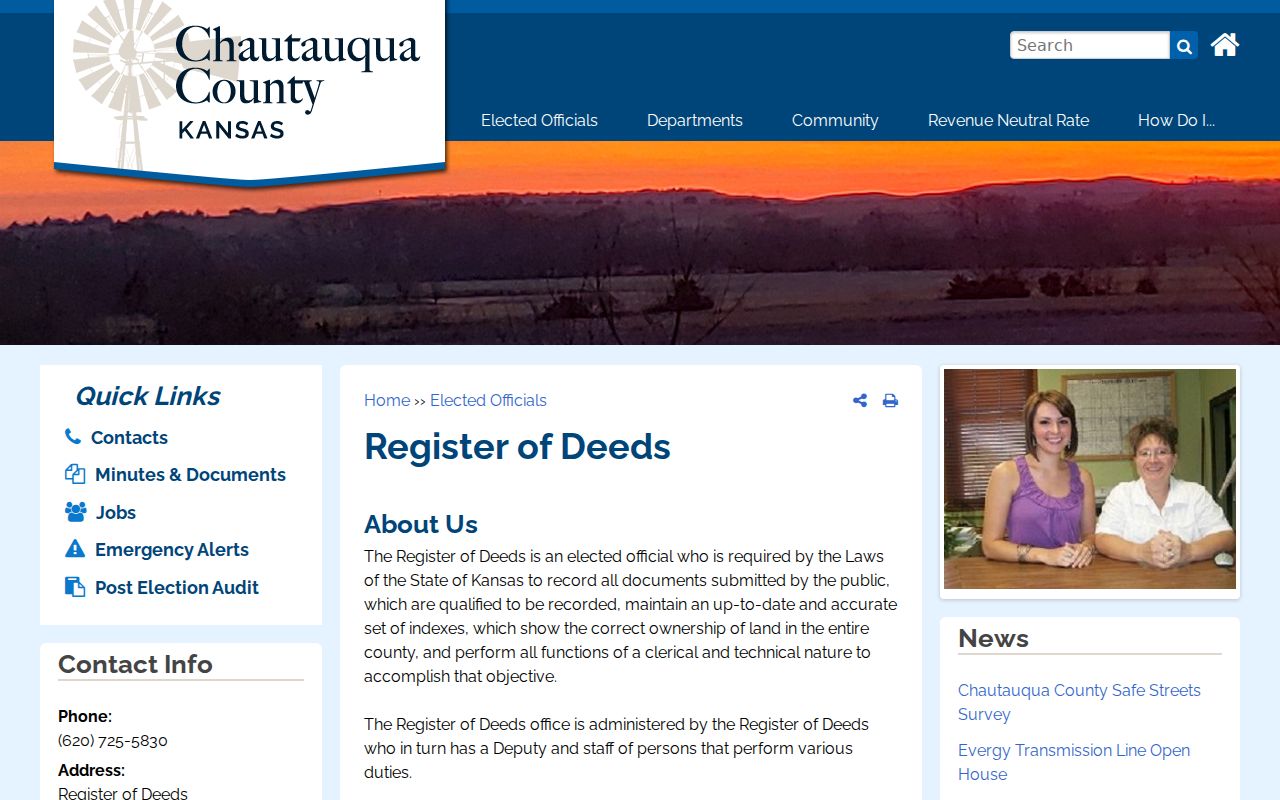
The Register records deeds, mortgages, liens, oil and gas leases, city-addition plats, and powers of attorney. Military discharges stay restricted. Its official page says ownership indexes cover the entire county. No search form appears there. No fee sheet or start year appears either. Call Register Laura C. Beeson at 620-725-5830 or email ccregdeeds@hotmail.com. Give grantor and grantee variants, approximate date, instrument type, legal description, and any known book/page or instrument number. Confirm page count, certification, payment, and delivery before ordering.
Use the returned recording reference to continue in the deed records guide.
Chautauqua County Property Maps Use ORKA
Kansas ORKA is the mapping starting point. It delivers property attributes, imagery, map search, and property-description reports for Chautauqua County parcels. Appraisal data refresh every two weeks; county mapping follows its own cadence. No county-specific live viewer, popup, or export exists.
The statewide REST service adds address points, subdivisions, lots and blocks, plat names, filing dates, and book and page fields. Treat those as leads. Not every layer runs locally. The parcel map guide shows how to carry them to official plats.
Chautauqua County Floodplain Records Reveal Fields
An April 10, 2026 county floodplain parcel list gives a rare public sample. It reveals the fields behind a parcel roll. It shows the long Parcel number, QuickRefID, PrimaryOwn, and PartyNames. Mailing and property addresses appear too, along with a “34S-1 New Floodplain” tag. Owners range widely. Trusts, entities, railroads, utilities, individuals, and government all appear, and some rows repeat.
The list covers a draft map review only. It is not a full owner roll, value card, title report, or final floodplain designation. Still, it shows exactly why identifiers and party fields must be preserved intact.
Match Chautauqua County Property Records to the Question
Ownership, value, tax status, map location, and litigation sit in separate Chautauqua County records. None substitutes for another. The strongest answer reconciles the relevant sets.
| Record Type | What It Documents | Kept By | Access |
|---|---|---|---|
| Deeds and ownership index | Recorded transfers and legal descriptions | Register of Deeds | Counter, phone, email, written request |
| Mortgages, liens and leases | Recorded claims, releases and land interests | Register of Deeds | Same offline-first route |
| Assessment | Parcel, class, appraised/assessed value and exemptions | Appraiser | Phone, counter, forms, KORA |
| Tax | Billing, payment, delinquency and sale | Treasurer | Static pages plus direct request |
| Plats and maps | Lot/block, additions and geographic reference | Register, ORKA, KDA | Recorded plat and agency maps |
| Property litigation | Foreclosure, quiet title, lien enforcement | 14th District Clerk | Kansas CaseSearch and clerk file |
Match the record to the question. Use property tax records for bills and appeals, the recorder for recorded ownership, and the court only when litigation affects the chain of title.
Chautauqua Tax Records Run on Two Calendars
Real-property taxes in Chautauqua County follow two deadlines. Installments fall due December 20 and May 10. No second-half statement goes out by mail. Interest starts December 21, and card payments carry a 2.49% charge. KDOR adds its own calendar: valuation notices March 1, a 30-day equalization appeal window, informal meetings by May 15, and final determination May 20.
The county billing page governs payment instructions. The KDOR calendar frames assessment review. Payment under protest must accompany the taxes and covers the entire amount.
Chautauqua County Property Tax-Sale Records
The county tax-sale table lists Parcel, Tax ID, Owner Name, and Property Address. It also lists City and Zip. The sale date reads TBA. Expect public notice four to six weeks ahead.
Resolution 2022-05 shows another path. Older county-held parcels could move from statutory sale and redemption into judicial foreclosure. Follow the Treasurer's status, the CaseSearch petition and judgment, and the Register's recorded conveyance. A static row proves neither present ownership nor marketable title.
Chautauqua County Early Property Records
The Kansas Historical Society dates the county's establishment and organization to 1875. A county-seat fight followed. Elk Falls held the records until Sedan prevailed. Sedan's first courthouse went up in 1877, and the present building dates to 1917–18. Ask which series holds an early paper rather than assuming it started in today's building.
KSHS plat atlases from 1903 and 1921 bridge old owner names to township and section. Old names snap into place there. The Chautauqua County Historical & Genealogical Society sits at 115 W Main in Sedan and offers seasonal research service at $10 per hour with 50-cent copies. Confirm hours and charges first.
Chautauqua County Property Court Records
Kansas CaseSearch lets you pull Chautauqua County case records through several filters: Search Type, a required Search Term, optional Case Type, plus date of birth and filing-date fields. When tracing a property dispute, try each owner name variant alongside terms like quiet title, foreclosure, mortgage, lien, tax foreclosure, and redemption. Remember that public case information here is not the official court record.
Need copies or clarification? The Chautauqua clerk sits on the courthouse third floor. Call 620-725-5870 during weekday hours, 8:00–12:00 and 1:00–4:00. Sealed, juvenile, expunged, adoption, and other protected records never appear in general public results.
KORA Keeps Offline Property Records Reachable
The county KORA policy asks for your name and contact details, plus a clear description of the Chautauqua County property records you want. Your request goes to the proper custodian. Staff act on requests promptly. K.S.A. 45-218 sets an outside limit of the third business day. Estimates, lawful exemptions, or a written delay explanation can follow that deadline. Fees are stated plainly. Paper copies run 25 cents a page, and electronic pages cost 12.5 cents each. Faxing adds 65 cents per ten pages. Mailing is billed at actual cost, and staff time is charged at the applicable pay rate. The office may require advance payment, and the originals stay with the office.
Set Limits on Chautauqua County Property Records
Each Chautauqua County property record answers one question. A deed index names recorded instruments and an assessment roll drives tax administration, while a tax-sale row shows a dated delinquency process. A GIS polygon is only a map reference. No single record proves clear title, exact boundary, occupancy, family relationship, current control, property condition, or sale value.
Lawful use. Use Chautauqua County property records for legitimate due diligence, estate, boundary, tax and history research. Never stalk, harass or harm a person named in a record.
Close with a Dated Source Audit
When Chautauqua County property records disagree, build a three-column audit across the newest recorded instrument, the Appraiser roll, and the Treasurer account. Preserve every identifier, record year, recording date, owner or taxpayer label, and the date you checked. The county publishes no assessment-roll lag figure. Flag each mismatch for the custodian. Boundary disputes need more. Add the recorded plat and a licensed survey. Foreclosure questions call for court and notice records, and historic ownership needs deed books, atlases, and newspapers, with the final conclusion always resting on an official instrument.
Decode Owner Names Before Linking Chautauqua Records
The index may list a trust under its trustee, its formal trust name, or both. Trusts deserve extra care in any Chautauqua County property search. Check LLCs and corporations in the Kansas Business Entity Search using exact and variant names. The state tool also accepts SOS ID and current resident-agent queries. Entity status, mergers, and former names are identity leads. The recorded deed remains the land evidence.
Estate research means searching the decedent, the estate, and the probate case. It also means searching the executor or administrator. A death certificate or obituary does not convey land. Locate the operative deed, affidavit, survivorship record, or court order. Same-name people need care. Compare address, legal description, dates, and related parties before joining two Chautauqua County records.
Historic Newspapers Extend a Chautauqua Land Search
The Kansas Historical Society newspaper database offers city, title, county, state, date-range, and sort controls. Microfilm may reach Kansas residents through interlibrary loan. Mine the pages for legal notices and probate. Look for sheriff or tax sales, courthouse events, and property descriptions too. Then verify each lead in the deed or court record.
Distinctive local phrases often beat a broad surname. Try “Elk Falls county seat” or “Sedan Town Company.” The Bradford or Eagle Hotel works. So do “water shipped,” “stock station,” or oil-lease terms. The local historical society's two-volume county history and its Cedar Vale history add citations. Neither substitutes for the recorded instrument.
Current Chautauqua Projects Need Date Labels
The 2026 KDA floodplain review and the April parcel list are timely geographic sources. Their draft or current-review status must travel with every citation. The February 2026 CAPSOL announcement is different. That public-information system delivers emergency alerts rather than property records. Keep the initiatives apart. The Appraiser's market-study page discusses assessment year 2026. It reported a broad 2025 residential trend of 0–12%, mostly 5–10%. Evidence for other property classes was limited or mixed. A stale-looking publication line there should not override the statutory calendar. It also should not override an individual valuation notice.
Compare Official Records with Compiled Data
| Source | Best evidence | Limit |
|---|---|---|
| County custodian | Dated deed, assessment, bill, plat or administrative record | Records remain separated by office |
| State portal | Court dockets, mapping framework, entity verification and valuation rules | Supplements rather than replaces county files |
| Historical repository | Atlases, newspapers, local histories and provenance | Leads require confirmation in instruments |
| Commercial compilation | Possible spelling or address lead | May be stale, merged, incomplete or unsupported |
Official does not always mean online. A direct request to a Chautauqua County office can beat a convenient third-party result. It names the custodian, the retrieval date, and the exact record. Treat a commercial match as a clue. Never treat it as proof that a person owns, occupies, or controls land.
Preserve Each Legal Description
Copy rural descriptions exactly. Preserve section-township-range, quarter-quarter, tract calls, metes and bounds, and every reservation or exception without alteration. For platted land, keep the subdivision or addition name, lot, block, plat book, and page. A parcel identifier helps staff retrieve a record. It does not erase the recorded description.
Cedar Vale's diagonal 1870 plan warns against assuming a standard grid. Sedan's original town-company and annexation history calls for plat-index searches under historic terms. Chautauqua's springs-era development does too. When a modern address and an older deed will not join directly, request the intermediate plat, replat, deed, or survey instead of guessing.
Keep Privacy Rules Attached to the Record Type
Open land records do not open every related record. Kansas vital certificates are restricted. A qualifying relationship, legal representation, direct interest, authorization, or identification applies as applicable. Voter-list access follows K.S.A. 25-2320 and strips Social Security and driver-identification numbers. Safe at Home gives qualifying victims substitute-address protection and must be handled with the relevant custodian.
County KORA exemptions can also shield protected identifying information. Court rules restrict sealed, juvenile, expunged, and adoption material. When a field is protected, cite the record type and access rule rather than reproducing sensitive data. Public names and addresses must never be used to threaten, intimidate, or harass.